06.11.25
LGBT-Straight Friendships: Getting Past the Misunderstandings
Last Updated 05.11.25
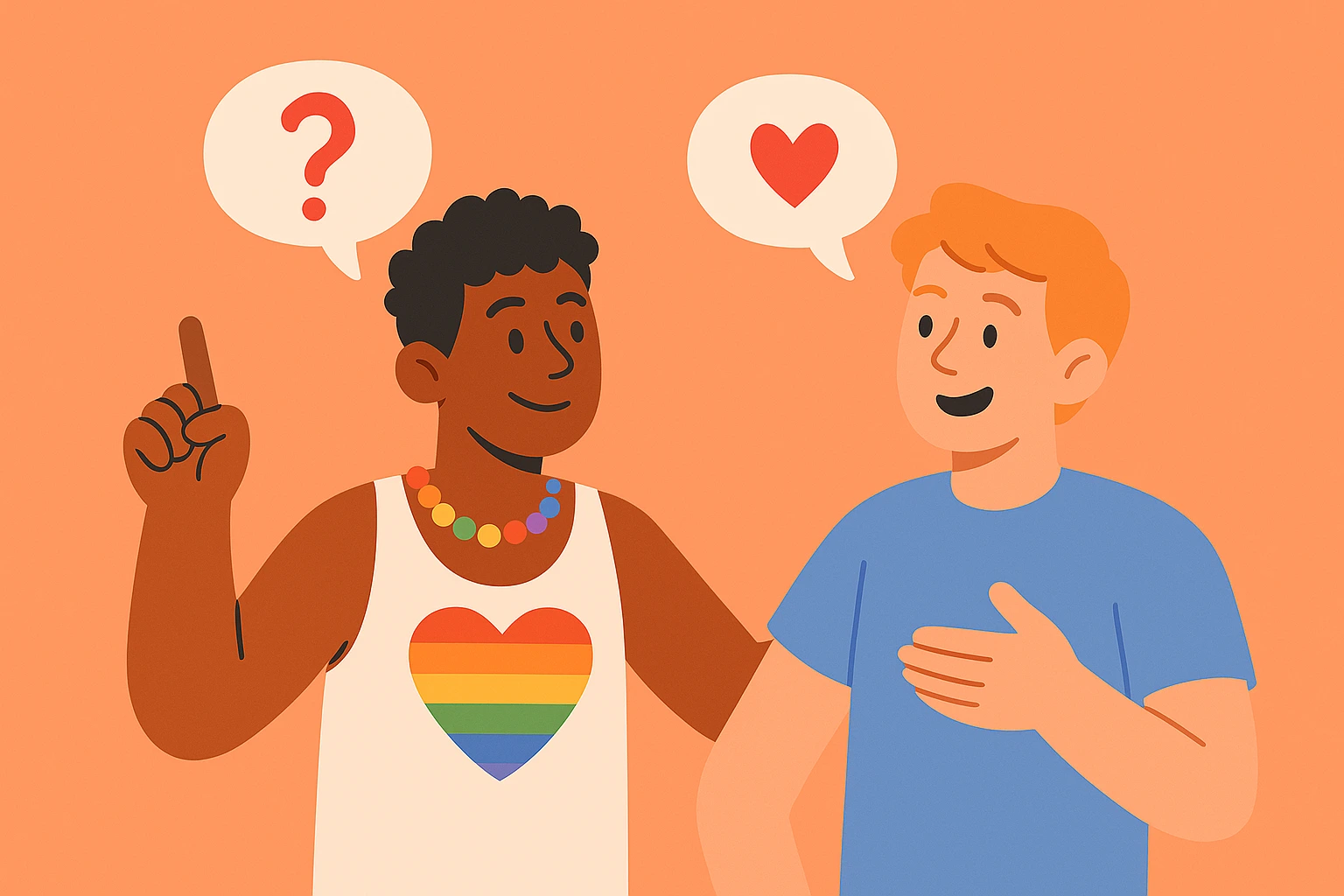
Your straight friend just made another awkward comment about your dating life. Or asked why you “have to make it such a big deal.” Or laughed at a joke that made your stomach drop. They’re not a bad person – you know this. They’ve been there for you through breakups and job losses and 3am anxiety spirals. But right now, you’re tired of explaining why that thing they just said wasn’t okay.
Here’s the truth nobody puts in those feel-good articles about diversity: even genuinely supportive straight friends will sometimes completely miss the mark. And figuring out how to handle that without either exploding or swallowing your frustration is one of the more exhausting parts of maintaining cross-orientation friendships.
Why Good People Say Stupid Things
Let’s start with the uncomfortable reality: your straight friends grew up in the same culture you did, which means they absorbed the same stereotypes, the same casual homophobia, the same assumptions about what’s “normal.” The difference is that you had to actively unlearn that stuff because it was about you. They didn’t have the same motivation.
Most straight people can go days, weeks, or even months without thinking about LGBT issues at all. It’s not malicious – it’s just not on their radar. They’re not navigating coming out conversations with new coworkers. They’re not calculating whether it’s safe to hold hands in a certain neighborhood. They’re not bracing themselves before mentioning a partner to someone new.
This creates a fundamental gap in understanding. What feels like basic respect to you might feel like “being political” to them. What’s a genuine safety concern for you might seem like paranoia to them. And what’s a microaggression that builds on a lifetime of similar comments might seem like a harmless joke to them.
None of this excuses thoughtless behavior. But it explains why someone who loves you can still hurt you without meaning to.
The Usual Suspects: Common Barriers
The “Why Are You So Sensitive?” Response
You point out that something bothered you, and suddenly you’re the problem for bringing it up. This is exhausting because it flips the script – instead of addressing what they said, you’re now defending your right to have feelings about it.
Jokes That Aren’t Actually Funny
That stereotype-based humor that makes everyone else laugh while you sit there deciding whether it’s worth ruining the mood. These jokes work because they rely on shared assumptions that you’re either not part of or actively harmed by.
The Privacy Paradox
“Why do you have to talk about your sexuality all the time?” Meanwhile, they’ve mentioned their spouse seventeen times today without it being “too much information.” Straight people don’t notice how often they reference their relationships and identity because it’s considered default.
Performative Allyship
The friend who posts rainbow flags during Pride Month but gets uncomfortable when you actually talk about LGBT issues. Support is great when it’s abstract, less great when it requires actual engagement or change.
The “I Don’t See It That Way” Defense
When you explain why something is hurtful and they counter with their interpretation, as if their intent matters more than your impact. This usually comes with “I didn’t mean it like that,” which might be true but doesn’t undo the damage.
Setting Boundaries Without Giving a TED Talk
You’re not obligated to educate everyone. You’re not a walking LGBT 101 course. But if you want to maintain the friendship, you’ll probably need to have some version of “the conversation.”
Keep it specific. Instead of “you need to be more aware of LGBT issues,” try “when you said X, it made me feel Y because Z.” Real example: “When you said finding a partner must be so much easier on dating apps because there are ‘so many options,’ it actually dismisses how exhausting and sometimes unsafe queer dating is.”
Use the word “I” a lot, not because they don’t deserve some “you” statements, but because it’s harder to argue with someone’s feelings than with accusations. “I felt uncomfortable” lands differently than “you made a homophobic joke.”
Set actual boundaries, not vague requests. “Please don’t make jokes about my sexuality” is clearer than “please be more respectful.” Give them specific things to do or not do, not abstract values to embody.
And here’s the part that sucks: you might need to say these things more than once. People forget. They slip back into old patterns. You’ll need to decide how many times you’re willing to repeat yourself before you’re done.
Responding Without Losing Your Mind
When someone says something ignorant, you have options beyond silently seething or unleashing a rant that ends the friendship.
The Gentle Correction
“Actually, it works differently than that.” Then move on. This works for minor misunderstandings where they genuinely didn’t know better.
The Question Method
“What made you think that?” or “Why do you think that’s funny?” Make them explain their logic. Sometimes people realize their own nonsense when they have to say it out loud.
The Direct Approach
“That comment bothered me. Here’s why.” No apologies, no softening, just clear information. Some people genuinely appreciate the directness.
The Exit Strategy
“I’m not getting into this right now.” Then change the subject or leave. You don’t owe everyone a debate.
The trick is matching your response to both the situation and your energy level. You’re allowed to phone it in sometimes. You’re allowed to let things go. You’re also allowed to push back hard when something crosses a line.
Building Understanding (When They’re Worth It)
If your friend is genuinely trying but just doesn’t get it yet, there are ways to help them develop empathy that don’t require you to trauma-dump or give lectures.
Consume media together. Watch a film or series with LGBT characters dealing with real issues, not just existing as comic relief or tragedy props. Afterwards, talk about it casually. “Did you notice how she had to come out to everyone she met?” Sometimes seeing it played out makes it click.
Share articles or videos that do the explaining for you. When someone else articulates something you’ve been trying to say, send it their way with “this is what I meant the other day.” Let the internet do some of your emotional labor.
Introduce them to your other LGBT friends if you’re comfortable. Seeing that your experience isn’t unique, that this is a pattern and not just your personal quirk, can be illuminating.
Tell them what good allyship actually looks like in practical terms. “I appreciate when you correct people who use slurs, even when I’m not in the room” is more useful than “be an ally.”
But here’s the thing: all of this only works if they actually want to understand. If they’re defensive every time you bring something up, or if they keep making the same mistakes without trying to change, education isn’t the issue. Willingness is.
When It’s Time to Step Back
Not every friendship survives this. And that’s okay.
If you’re constantly explaining basic respect, you’re not in a friendship – you’re in an unpaid teaching position with someone who’s not even taking notes.
If they get angry when you set boundaries, they care more about their comfort than your wellbeing.
If they support you in theory but disappear when you actually need them, that’s fair-weather friendship at best.
If being around them requires you to dim yourself, to avoid certain topics, to laugh at jokes that hurt you – that’s not support. That’s tolerance, and you deserve better than being tolerated.
Stepping back doesn’t have to mean a dramatic confrontation. Sometimes friendships just fade because you stop putting in the effort to maintain them. You get busy, you’re less available, you invest your energy elsewhere. That’s valid.
Sometimes you need a clean break. “I don’t think this friendship is working for me anymore” is a complete sentence. You don’t owe them a detailed explanation or a chance to change your mind.
The friendships worth keeping are the ones where both people are willing to be uncomfortable sometimes. Where they listen when you say something hurt, where they actually modify their behavior, where they show up not just for the easy parts but for the complicated ones too.
The Bottom Line
Friendship between LGBT and straight people isn’t inherently harder – but it does require straight friends to acknowledge that they don’t automatically understand your experience. The good ones will admit their ignorance and try to do better. The mediocre ones will get defensive. The bad ones will make it your fault for being upset.
You’re not asking for special treatment. You’re asking to be seen as a full person, to exist without constant explanation or justification, to have your boundaries respected. That’s baseline friendship stuff, not some elevated standard.
The right people will meet you there. They might stumble, they might need guidance, but they’ll show up and try. The ones who don’t – let them go. Your energy is better spent on people who think you’re worth the effort of understanding.
And if you’re exhausted from explaining, from setting boundaries, from having the same conversations over and over – that’s not a personal failing. That’s a reasonable response to an unreasonable amount of emotional work. You’re allowed to be tired. You’re allowed to want friendships that don’t require a syllabus.
Good friendships grow both people. If yours is only growing in one direction – with you constantly stretching to accommodate them while they stay comfortably where they are – it might be time to find people who’ll meet you halfway.

James Wilson
James Wilson holds a Ph.D. in Psychology from Columbia University, where he specializes in human sexuality research. With 12 years of clinical experience counseling individuals exploring their sexual orientation, he has authored two books on sexual identity development. Dr. Wilson serves on the board of the American Psychological Association's Division 44 and frequently conducts workshops for healthcare providers on culturally competent care for LGBTQ+ individuals.