06.11.25
Fighting Internalized Homophobia and Shame: A Practical Guide
Last Updated 14.10.25
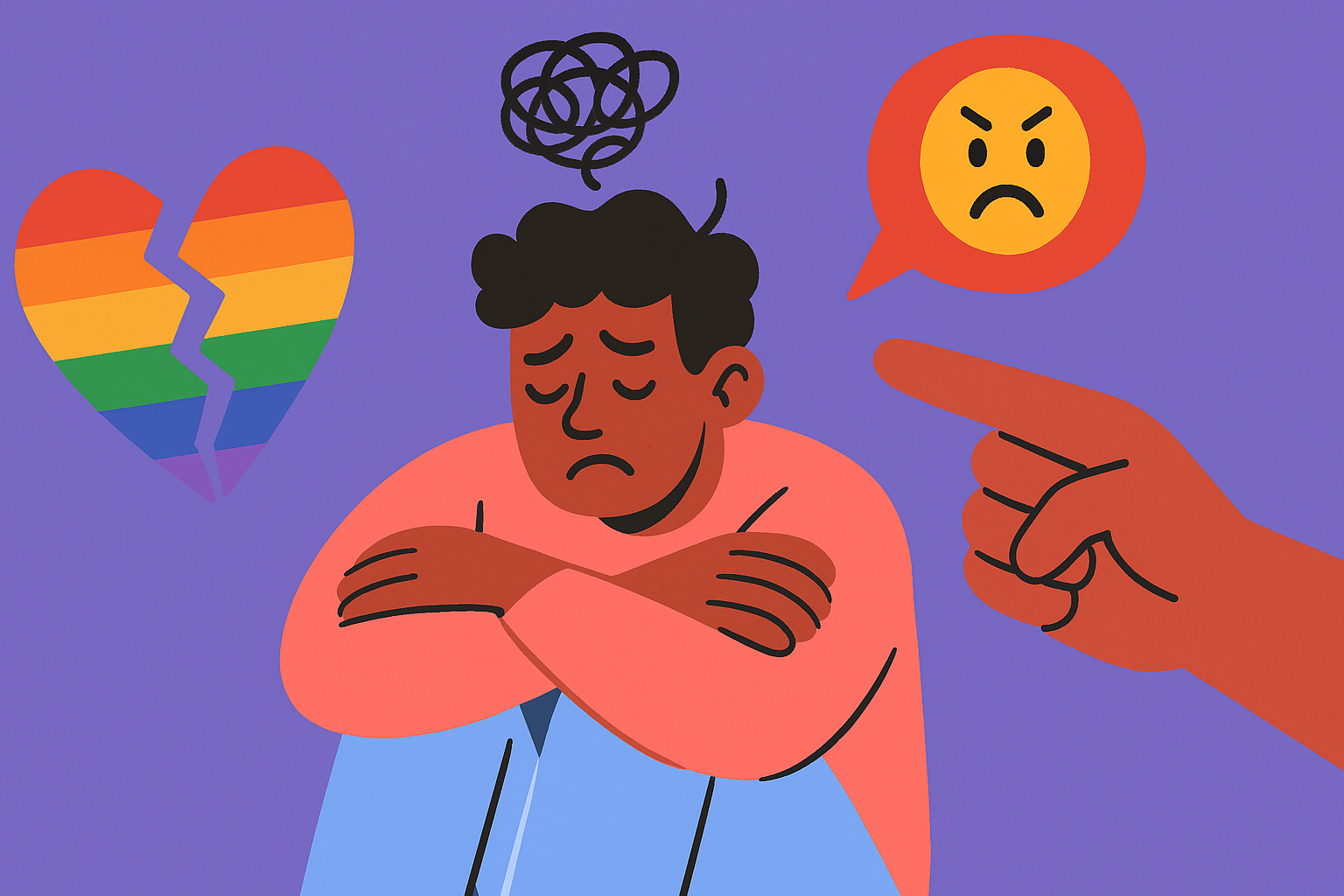
Let’s get one thing straight: if you’re LGBTQ+ and dealing with shame about who you are, you didn’t just wake up one day and decide to hate yourself. That shame was carefully installed in your brain over years, sometimes decades, by a society that still hasn’t fully figured out that queer people are just… people.
Internalized homophobia is what happens when you absorb all those negative messages about LGBTQ+ identities and turn them inward. Maybe it was your religious upbringing teaching you that being gay was sinful. Maybe it was watching TV shows where queer characters were punchlines or tragic figures. Maybe it was hearing your dad use “gay” as an insult, or your mom’s uncomfortable silence when same-sex relationships came up. Maybe it was all of the above, repeated so many times that it became background noise.
The tricky part? This stuff burrows deep. Even after you come out, even after you intellectually accept your identity, those old messages keep playing on loop. You might consciously know there’s nothing wrong with being queer, but some part of your brain is still running that outdated software.
Signs You’re Dealing With Internalized Homophobia
Here’s what this actually looks like in real life, not the textbook version:
You police your own behavior constantly. You catch yourself monitoring how you walk, talk, or gesture. You avoid certain clothes or interests because they’re “too gay.” You might even feel embarrassed when other LGBTQ+ people are “too obvious” about their identity because part of you still believes visibility equals something negative.
You have different standards for yourself than for others. You’re fine with your friends being openly queer, but when it comes to your own life, you hold back. You rationalize this as being “private” or “professional,” but really, you’re operating from a place of shame.
You struggle with LGBTQ+ spaces and community. You avoid Pride events, queer bars, or LGBTQ+ organizations. You might tell yourself you “don’t need labels” or you’re “not like other gay people,” but underneath, there’s discomfort with being fully associated with the community.
Your dating life is a mess of contradictions. You’re only attracted to “straight-acting” people. You won’t date anyone who’s out on social media. You have elaborate rules about what’s acceptable and what’s “too much.” These aren’t just preferences – they’re shame-based boundaries.
You experience intense anxiety around being perceived as LGBTQ+. Even when you’re out, the thought of strangers clocking you as queer causes disproportionate stress. You replay interactions in your head, worried about whether you seemed “too gay.”
You engage in comparative suffering. “At least I’m not…” becomes a common thought pattern. You rank types of queerness, usually placing yourself in whatever category you’ve deemed more acceptable.
Methods for Working With Yourself
Alright, enough diagnosis. Let’s talk about what actually helps.
Reevaluating Negative Beliefs
This is cognitive work, and yeah, it’s not sexy or exciting, but it works. The technique is straightforward: identify the specific negative thoughts, examine them critically, and actively replace them with more accurate beliefs.
Start by writing down the actual thoughts that run through your head. Not vague feelings – specific sentences. Things like “Real men don’t act like this” or “I’m embarrassing” or “Nobody will take me seriously if they know I’m gay.”
Then, for each thought, ask yourself: Where did this come from? Who taught me this? Is there actual evidence for this belief? What would I tell a friend who said this about themselves?
Here’s an example: “I need to act more masculine or people won’t respect me.”
Break it down: This probably came from cultural messaging that equates masculinity with value. Is there evidence? Well, you likely know plenty of people who respect individuals across the gender expression spectrum. You’ve probably been respected when you were just being yourself. The belief doesn’t hold up under scrutiny.
The replacement thought isn’t some affirmation like “I’m perfect as I am.” It’s more practical: “Some people might judge me based on gender expression, but plenty won’t, and their opinion matters more. Also, performing masculinity I don’t feel is exhausting and inauthentic.”
Do this repeatedly. Your brain has practiced the negative thought for years – you need to practice the alternative just as much.
Finding Role Models (Real Ones)
This isn’t about putting queer celebrities on a pedestal. It’s about seeing examples of LGBTQ+ people living regular, functional lives in ways that feel relevant to you.
Look for people in your actual field of work, your hobbies, your city. If you’re a teacher, find out about queer educators. If you’re into rock climbing, look for LGBTQ+ climbing communities. The specificity matters because it directly contradicts the limiting beliefs your brain has been running.
When you see a queer person doing something you want to do – whether that’s having a stable relationship, advancing in their career, or just seeming comfortable in their own skin – it chips away at the narrative that being LGBTQ+ is incompatible with those things.
And crucially, look for diverse examples. Find people who are more visible than you, less visible than you, different types of queer identities, different presentations. This prevents you from just creating a new, narrow box of “acceptable queerness” to squeeze yourself into.
Self-Education That Actually Matters
Reading queer history isn’t just about feeling connected to a legacy – though that helps. It’s about understanding that the negative messages you internalized are relatively recent social constructs, not eternal truths.
Learning about how homosexuality was pathologized, how gender norms shifted over time, how different cultures have understood LGBTQ+ identities – this context makes it harder to view your identity as inherently problematic. It’s external, cultural stuff that was imposed, not something fundamentally wrong with you.
Also, educate yourself about the specific intersection of your identities. If you’re a queer person of color, understanding both racial and LGBTQ+ history matters. If you’re trans, learning about the medical establishment’s historical treatment of trans people helps contextualize any shame you might feel about your body or identity.
Read memoirs, but also academic work if that’s your thing. Listen to podcasts. Watch documentaries. The goal is to fill your brain with alternative narratives to the shame-based ones.
The Role of Therapy and Community
Let’s be honest: you can do a lot of this work on your own, but therapy and community speed up the process significantly.
Therapy specifically helps with the deep stuff. A good therapist – ideally one who’s LGBTQ+-affirming or queer themselves – can help you identify patterns you don’t see, challenge beliefs that seem too scary to question alone, and provide support when the work gets hard. Look for therapists trained in cognitive-behavioral therapy (CBT) or acceptance and commitment therapy (ACT), both of which have solid evidence for helping with internalized stigma.
If you can’t access therapy right now, there are online resources and workbooks specifically designed for working through internalized homophobia. They’re not as effective as working with someone, but they’re better than nothing.
Community provides the lived proof. Being around other LGBTQ+ people – especially ones who’ve worked through their own internalized homophobia – shows you it’s possible. You see people who’ve been where you are and came out the other side. You witness different ways of being queer, which expands your sense of what’s possible for yourself.
This doesn’t mean you have to become super involved in LGBTQ+ organizations if that’s not your thing. It can be as simple as having a few queer friends, joining an online community, or attending occasional events. The key is regular contact with people who aren’t operating from the same shame framework.
One warning: be mindful of community spaces that reinforce rigid norms about how to “properly” be LGBTQ+. Some spaces can paradoxically recreate the same judgment and policing that contributed to your internalized homophobia in the first place. Look for communities that embrace diversity within the LGBTQ+ umbrella.
Tracking Your Progress
How do you know if this work is actually helping? Here are concrete signs:
You catch yourself less often. Those negative thoughts still pop up, but you notice them sooner and they don’t spiral as much. You can identify them as internalized homophobia rather than just “how things are.”
Your behavior changes. You’re more willing to be visible. You stop editing yourself as much. You engage with LGBTQ+ content or spaces without that knee-jerk discomfort. Small actions that previously felt impossible start feeling manageable.
Your standards for yourself align more with your standards for others. If you wouldn’t judge a friend for being openly queer, you start extending that same acceptance to yourself.
You experience less anxiety around being perceived as LGBTQ+. It’s not that you become completely unbothered – we live in a homophobic society, so some level of awareness is realistic – but the intensity decreases. Being clocked as queer stops feeling like a catastrophe.
Your relationships improve. You’re able to be more authentic with partners, friends, and family. You stop compartmentalizing your life so rigidly. You can talk about your relationships or identity without that underlying sense of shame.
You have more energy. This is a big one people don’t talk about enough. Maintaining internalized homophobia is exhausting – you’re constantly monitoring yourself, suppressing things, managing anxiety. As you work through it, you literally have more mental and emotional bandwidth for other parts of your life.
Document these changes. Keep notes on your phone, journal, whatever works. When you’re having a rough day and feeling like you haven’t made progress, you can look back and see concrete evidence that things have shifted.
Acceptance as Process, Not Destination
Here’s the reality: working through internalized homophobia isn’t a neat narrative with a clear endpoint where you suddenly love everything about being queer and never struggle again. That’s not how this works.
You’ll have good periods and rough patches. Something will trigger that old shame – a family event, a news story, a random comment from a stranger – and suddenly you’re back in it. That doesn’t mean you’ve failed or lost your progress. It means you’re human, and you’re still living in a society that hasn’t fully caught up.
The difference is that over time, you develop tools. You know how to talk yourself through it. You have people you can reach out to. You recognize the internalized homophobia for what it is – old programming running its course – rather than truth about who you are.
Some days, acceptance looks like actively celebrating your identity. Other days, it looks like just not hating yourself. Both count.
The goal isn’t to reach some perfect state of self-love where being LGBTQ+ only fills you with pride and joy. The goal is to get to a place where your identity is simply part of who you are – neither your entire personality nor a source of constant shame. Just one aspect of a complex human trying to live their life.
That’s achievable. Not easy, not quick, but achievable. And worth the work.

Elena Rodriguez
Elena Rodriguez earned her Ph.D. in Sociology from NYU, focusing on relationship structures and romantic attraction patterns across diverse populations. She directs the Center for Relationship Studies at Stanford University and has pioneered research on aromantic, demiromantic, and other romantic orientations. Dr. Rodriguez regularly contributes to relationship education programs and has developed curriculum materials used in universities nationwide to help students understand the spectrum of romantic experiences.