06.11.25
How to Explain Your Identity to People Who Don’t Get LGBTQ+
Last Updated 15.10.25
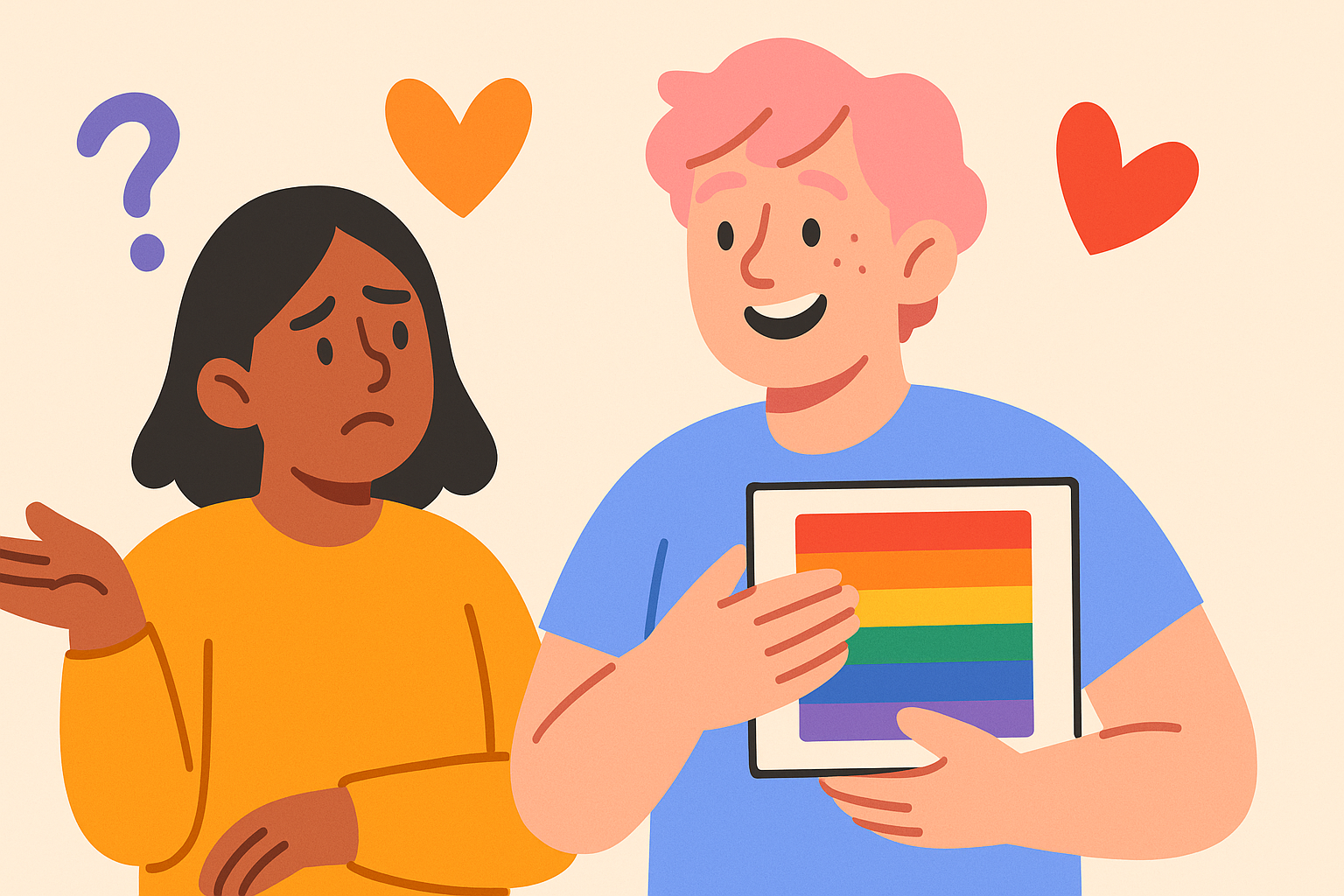
So there you are, sitting across from someone who just asked “But what does that actually mean?” about your identity. Maybe it’s a family member, a coworker, or someone you’re trying to date. Your brain scrambles for words while they wait with genuine confusion on their face. Or worse – with that look that says they’ve already decided you’re making things up.
Here’s the thing nobody tells you: explaining your identity to someone who doesn’t understand LGBTQ+ stuff is exhausting. It’s emotional labor. And you’re not always going to get it right, because sometimes there’s no “right” way to make someone understand something they’re determined not to get.
But when you do want to try – whether because you care about this person, or you’re stuck at Thanksgiving dinner, or you just really need your HR department to use your correct pronouns – having a game plan helps.
Size Up Your Audience First
Before you launch into Identity 101, take a minute to figure out who you’re dealing with. Not everyone deserves your time and energy.
Good signs someone’s worth talking to:
- They’re asking questions instead of making statements
- They admit they don’t know much about this
- They’ve messed up your pronouns but they’re actively trying to correct themselves
- They seem uncomfortable because they’re worried about getting it wrong, not because you exist
Red flags that this conversation will go nowhere:
- They keep saying “I’m just being honest” before something offensive
- Every question starts with “But don’t you think…”
- They bring up their one LGBTQ+ friend/relative as proof of expertise
- They’re clearly waiting for their turn to talk, not actually listening
If you spot those red flags, you can save yourself a headache. Remember: you don’t owe anyone an education, especially not people who treat your identity like a debate topic.
Breaking Down the Basics (Without a PhD)
When someone genuinely doesn’t understand LGBTQ+ terminology, the academic definitions often make things worse. “Gender identity is an internal sense of self distinct from biological sex” sounds great in a textbook, but it means nothing to your uncle at a barbecue.
Try this instead:
For sexual orientation: “You know how you’re attracted to [whoever they’re attracted to]? Same thing, but for me it’s [your orientation]. It’s not complicated – it’s just who I am.”
For gender identity: “Most people are fine with the gender they were assigned at birth. I’m not. My brain and body didn’t match up the way they were supposed to, so I’m fixing that.”
For non-binary identities: “The whole ‘pick one: man or woman’ thing doesn’t work for me. Some people are tall, some are short, some are in between. Gender’s more flexible than you’d think.”
For asexuality: “I don’t experience sexual attraction the way most people do. It’s not about being picky or waiting for the right person – it’s just not part of how I’m wired.”
Notice what these explanations don’t do: they don’t apologize, they don’t over-explain, and they don’t treat your identity like it needs defending. You’re stating a fact, not asking permission.
Metaphors That Actually Work
Sometimes people need comparisons to wrap their heads around things. But please, for the love of everything, retire the “gender is a spectrum” line. It’s been done to death, and it doesn’t help as much as you think.
Better options:
For understanding transition: “Think about wearing shoes that are two sizes too small every single day. Everyone tells you the shoes are fine, that you’ll get used to them, but they’re causing real damage. Would you keep wearing them just because other people can’t see the problem?”
For explaining attraction fluidity: “You liked different foods as a kid than you do now, right? But you probably also have foods you’ve always loved and always hated. People aren’t that different – attraction can be consistent and change over time.”
For gender dysphoria: “You know that feeling when you hear your voice in a recording and it sounds wrong? That disconnect between what you expect and what you experience? That’s sort of what gender dysphoria feels like, except it’s constant and it’s about your entire body and how people see you.”
The key is picking metaphors that connect to their actual experiences, not abstract concepts.
Handling the Greatest Hits of Stupid Questions
Let’s be real: you’re going to hear the same tired arguments over and over. Here are the most common ones and how to shut them down without losing your mind.
“Isn’t this all just a trend?” “Weird trend, considering people have been killed over it. Also, if this was a trend, I could just stop when it got inconvenient. Trust me, I would’ve done that already.”
“But you don’t look gay/trans/bi” “What exactly does [identity] look like? Because last I checked, we don’t come with uniform requirements.”
“How do you know if you haven’t tried [sex/dating/living as your assigned gender]?” “How do you know you’re straight if you haven’t tried being gay? See how that question is invasive and makes no sense?”
“What about the children?” “What about them? LGBTQ+ people exist regardless of whether kids know about us. Pretending we don’t exist doesn’t make kids straight – it just makes queer kids feel alone.”
“This is all so confusing/complicated” “It’s not confusing to me – I live it every day. If you’re confused, that’s fine, but your confusion doesn’t make my identity less valid.”
Here’s your script for when someone gets aggressive: “I tried to explain this to you because I thought you wanted to understand. If you’re not actually interested in understanding, we can talk about something else.” Then change the subject or leave. You’re not a punching bag.
Know When to Tap Out
Sometimes the smartest thing you can do is not engage at all.
Don’t bother explaining when:
- Someone’s already been hostile or dismissive multiple times
- You’re in a vulnerable position (like at work with your boss, or with a parent you’re financially dependent on)
- Your mental health is already struggling
- The person has made it clear they think your identity is a phase, illness, or choice
- You’re the only LGBTQ+ person in the room and everyone’s staring at you to represent the entire community
There’s this weird pressure in queer spaces that says we should always educate, always be patient, always take the high road. Screw that. Your mental health and safety matter more than someone else’s enlightenment.
If someone really wants to understand LGBTQ+ issues, they have Google. They have books. They have countless resources that don’t require you to relive your trauma or justify your existence over coffee.
You Don’t Owe Anyone Anything
Let’s end with something important: you are not required to explain yourself.
Not to your family. Not to your friends. Not to strangers on the internet who think they deserve a dissertation on your identity because they asked “politely.”
Some people will get it. Some won’t. Some will try, mess up, try again, and eventually become your biggest supporters. Others will make it clear that no explanation will ever be good enough because they’ve already decided you’re wrong.
The ones who matter will meet you halfway. They’ll stumble over pronouns and terminology, sure, but they’ll try. They’ll listen when you correct them. They’ll do their own research instead of expecting you to be a walking encyclopedia.
And the ones who don’t? They’ve told you who they are. Believe them.
Your identity isn’t up for debate. You’re not a theory or a controversy or a political statement. You’re a person who exists, and that existence doesn’t require anyone else’s approval or understanding.
So explain when you want to, when it feels safe, when you think it might actually help. But never forget: you don’t need to justify yourself to anyone. You’re already valid, whether they get it or not.
The right people will figure it out. The wrong people were never going to understand anyway. And you? You’re going to be fine either way.

James Wilson
James Wilson holds a Ph.D. in Psychology from Columbia University, where he specializes in human sexuality research. With 12 years of clinical experience counseling individuals exploring their sexual orientation, he has authored two books on sexual identity development. Dr. Wilson serves on the board of the American Psychological Association's Division 44 and frequently conducts workshops for healthcare providers on culturally competent care for LGBTQ+ individuals.