06.11.25
Why Gender and Orientation Are Spectrums, Not Boxes
Last Updated 15.10.25
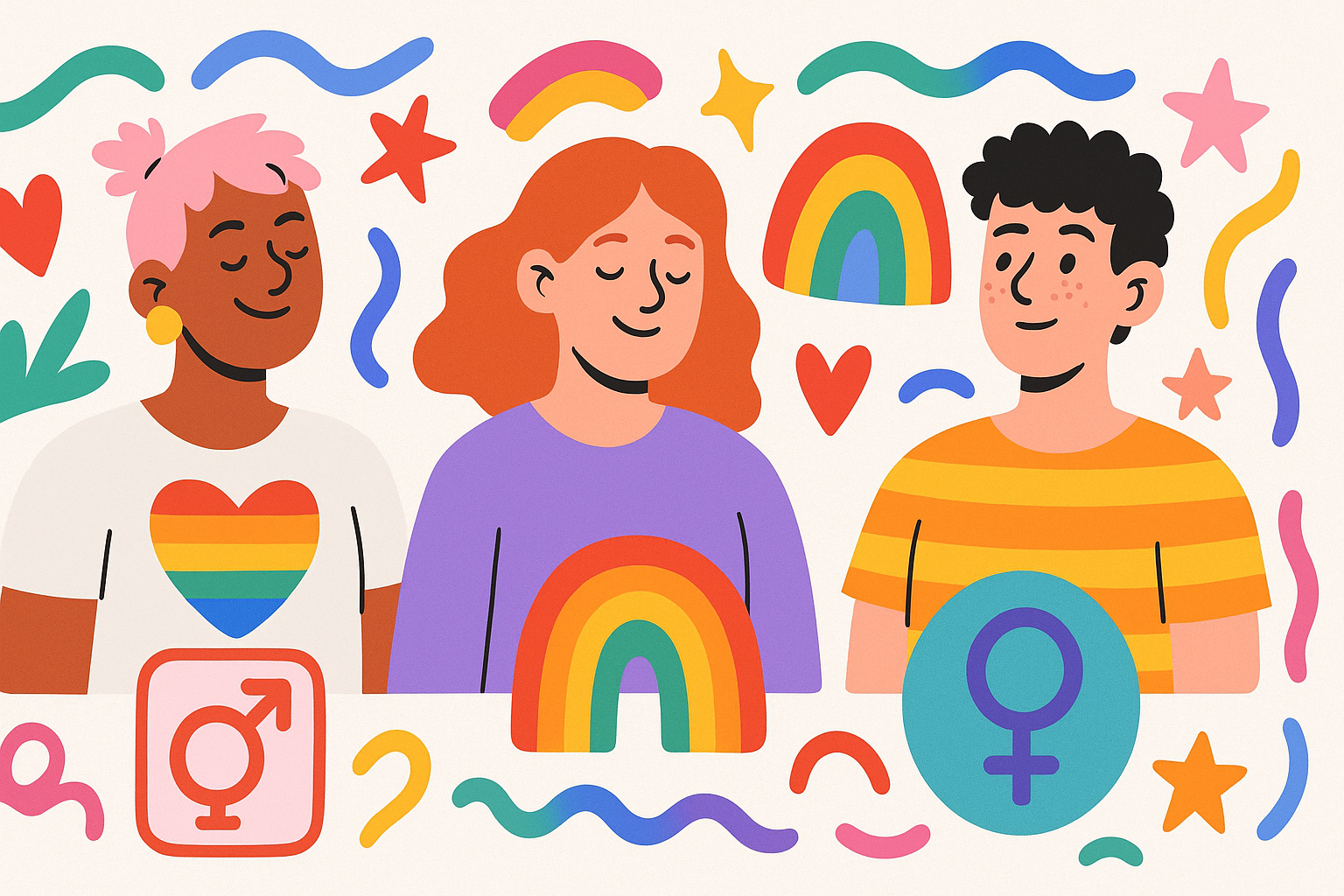
You know what’s weird? Every time you fill out a form, you’re expected to reduce the entirety of your gender and sexuality to a single checkbox. M or F. Sometimes they throw in “Other” like that covers the remaining 7 billion variations of human experience. It’s like asking someone to describe their favorite food but only giving them two options: “apple” or “not apple.” Reductive doesn’t even begin to cover it.
The truth is, gender and sexual orientation exist on spectrums—multiple spectrums, actually. But we’ve been conditioned to think in binaries for so long that even suggesting otherwise can feel radical. Let’s break down why the box system doesn’t work and what actually does.
Where the “Two Boxes” Idea Came From
The strict male/female binary didn’t just fall from the sky. It’s a relatively recent Western construct that gained power through colonialism, religious doctrine, and medical institutions deciding they knew best.
Many cultures historically recognized more than two genders. Indigenous North American communities had Two-Spirit people. South Asian cultures recognized hijra. Samoa has fa’afafine. These weren’t fringe concepts—they were integrated parts of society. Then European colonizers showed up with their “there are only two genders and everyone must fit” mentality and enforced it through law, medicine, and violence.
The medical establishment really doubled down in the 19th and 20th centuries. Doctors started performing surgeries on intersex infants to make their bodies “fit” male or female categories, often causing lifelong trauma. Psychology pathologized anyone who didn’t conform to strict gender roles. Homosexuality was literally classified as a mental illness until 1973 in the U.S.
So when people say the binary is “natural” or “traditional,” they’re actually defending a fairly recent, culturally specific idea that was violently imposed on much of the world.
Gender Isn’t One Thing—It’s Several
Here’s where it gets interesting: what most people call “gender” is actually several different concepts mashed together.
Biological sex includes chromosomes, hormones, internal and external anatomy. And even this isn’t binary. About 1.7% of people are born intersex—that’s roughly the same prevalence as red hair. Intersex conditions include variations in chromosomes (like XXY or XO), hormone production, and anatomical development. Some people don’t find out they’re intersex until puberty or even later.
Gender identity is your internal sense of your gender. This is neurological, psychological, and yes, it’s real. Transgender people’s brain scans often show patterns more similar to their identified gender than their assigned sex. This isn’t about preference or choice—it’s about who you fundamentally are.
Gender expression is how you present your gender to the world through clothing, behavior, voice, and manmannerisms. Here’s the thing: a man in a dress is still a man if that’s his identity. A woman with short hair and traditionally masculine clothing is still a woman. Expression and identity aren’t the same thing.
All three of these exist on continuums. You can have XY chromosomes, identify as nonbinary, and express yourself in a feminine way. You can be XX, identify as a woman, and express yourself in a masculine or androgynous way. The combinations are endless because humans are complex.
Sexual Orientation Gets Complicated Too
Remember learning that people are either gay or straight? Yeah, that was also oversimplified to the point of uselessness.
Alfred Kinsey messed this up in the 1940s (in a good way) with his research showing that sexuality exists on a scale from exclusively heterosexual to exclusively homosexual, with most people falling somewhere in between. But even that didn’t capture everything.
Sexual attraction and romantic attraction can be different. You might be sexually attracted to multiple genders but only romantically attracted to one. Or vice versa. This is why the split attraction model exists—it gives people language for these distinctions.
Asexuality is a whole spectrum unto itself. Some asexual people experience no sexual attraction ever. Some experience it rarely (gray-asexual). Some experience it only after forming emotional bonds (demisexual). All of these are valid orientations, not disorders or phases.
And then there’s fluidity. Some people’s attractions shift over time. This isn’t being “confused”—it’s just how sexuality works for some folks. The idea that your orientation is fixed for life is another assumption that doesn’t hold up when you actually listen to people’s experiences.
What Spectrums Actually Mean
Let’s talk about what thinking in spectrums actually looks like, because “spectrum” has become kind of a buzzword without much explanation.
Think about biological sex characteristics. Instead of two categories, you have multiple traits that each exist on a continuum: chromosomal patterns, hormone levels, internal reproductive anatomy, external anatomy, secondary sex characteristics. Each person has a unique combination of where they fall on each of these spectrums.
For gender identity, there’s not just one line from male to female with nonbinary in the middle. Some people are agender (no gender). Some are genderfluid (shifting). Some are bigender (experiencing two genders). Some are outside this framework entirely. It’s less like a single spectrum and more like multidimensional space.
Same with orientation. You’ve got the gender(s) you’re attracted to, the intensity of that attraction, how often you experience it, whether it’s sexual or romantic or both, and how those patterns might shift over time. That’s not a line—that’s a whole matrix of possibilities.
The point isn’t that everyone needs to find their exact coordinates on all these spectrums. The point is that rigid categories fail to describe reality, and that failure causes real harm.
Why This Actually Matters
This isn’t abstract theory. Understanding gender and orientation as spectrums has concrete impacts on people’s lives.
Mental health: Studies consistently show that LGBTQ+ people who have language for their identities and feel validated in them have significantly better mental health outcomes. Conversely, forcing people into categories they don’t fit causes measurable psychological distress. The pressure to be “one or the other” contributes to higher rates of anxiety, depression, and suicidality in queer communities.
Medical care: When doctors understand that sex and gender are complex, they provide better healthcare. This includes appropriate care for intersex people (without unnecessary surgeries), proper hormone therapy for trans people, and not making assumptions about someone’s anatomy based on how they look.
Self-understanding: Having the language to describe your experience is huge. The number of people who’ve said “I thought I was broken until I learned about [insert term]” is staggering. Whether it’s demisexuality, genderfluid, or any other term, having words for your experience validates that you’re not weird or wrong—you’re just you.
Community: Understanding spectrums helps build better LGBTQ+ communities. Instead of gatekeeping who’s “really” queer, we can recognize that people at all points on these various spectrums belong. It reduces infighting and creates space for more people to find support.
Legal and social recognition: Policy works better when it reflects reality. Binary gender markers on IDs don’t work for nonbinary people. “Sexual orientation” protections that only consider gay/straight don’t protect bisexual people adequately. The more we understand complexity, the better our systems can accommodate everyone.
Real Talk About Labels
Here’s something people get wrong: understanding that gender and orientation are spectrums doesn’t mean you need to adopt complicated labels or figure out exactly where you fall.
Labels are tools. Use them if they’re helpful. If “queer” as a broad term works for you, great. If you need more specific language like “panromantic asexual,” that’s also great. If you prefer not to label yourself at all, that’s fine too.
The spectrum model is descriptive, not prescriptive. It describes the diversity that already exists. It’s not telling anyone they need to be complex or figure everything out. It’s just saying that wherever you are on these various continuums, you’re legitimate.
Some people know exactly who they are from a young age. Others figure it out gradually. Some people’s identities and orientations shift over time. All of these paths are normal.
The Takeaway: Diversity Is the Baseline
Here’s what we’ve covered: the binary model of gender and sexuality is a recent cultural construct that doesn’t match biological, psychological, or social reality. What we call “gender” is actually multiple different traits—sex characteristics, identity, and expression—each existing on its own spectrum. Sexual orientation is similarly complex, involving different types of attraction that can vary in intensity and shift over time.
This isn’t new-age thinking or political correctness gone wild. It’s what the data shows when you actually study human diversity without trying to force everyone into predetermined boxes. The binary isn’t “traditional”—it’s recent and culturally specific. Diversity is what’s actually traditional and universal.
For queer people navigating their identities, understanding spectrums offers permission to exist as you are without apologizing for not fitting neat categories. You’re not “too complicated” or “special snowflake-ing”—you’re literally just existing as a human being with a complex identity.
For allies, this framework demands that you update your understanding of gender and sexuality to match reality. That means using people’s pronouns, not assuming anyone’s orientation or identity, and supporting policy that reflects human diversity rather than outdated binary thinking.
The boxes were always too small. It’s time we acknowledged that and built systems—social, medical, legal—that actually accommodate the full range of human experience. Not because it’s trendy or political, but because it’s accurate and because people’s wellbeing depends on being seen and accepted as they actually are.

Elena Rodriguez
Elena Rodriguez earned her Ph.D. in Sociology from NYU, focusing on relationship structures and romantic attraction patterns across diverse populations. She directs the Center for Relationship Studies at Stanford University and has pioneered research on aromantic, demiromantic, and other romantic orientations. Dr. Rodriguez regularly contributes to relationship education programs and has developed curriculum materials used in universities nationwide to help students understand the spectrum of romantic experiences.